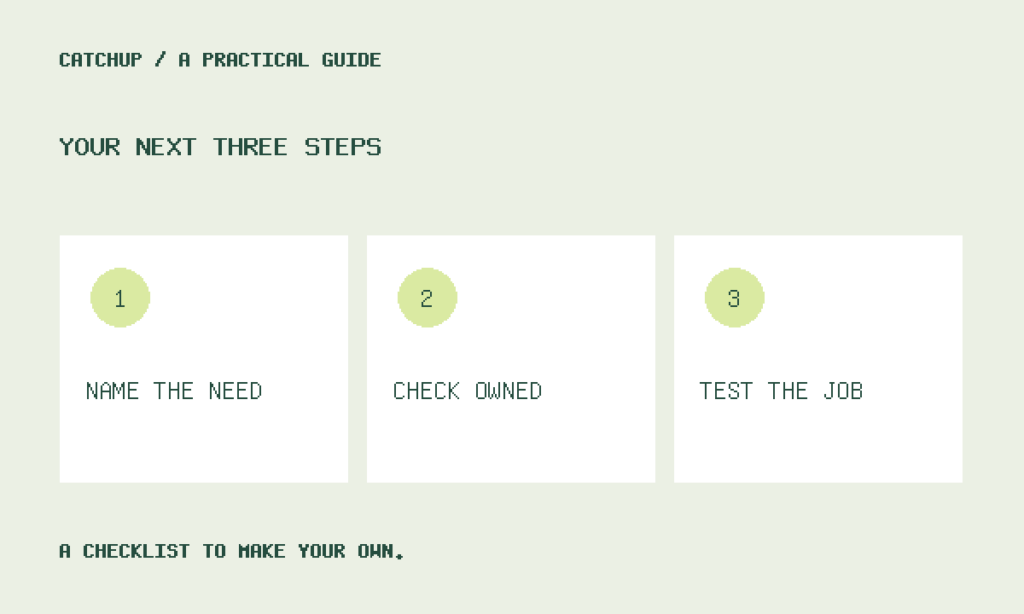
Give each candidate a need check and a current-job check. Keep the existing setup, reassign an available item, or record the specific need that remains unmet.
An empty pouch in a closet can be easy to overlook when the bag you use every day feels disorganized. But moving that pouch into service only helps if it solves the reason you wanted a replacement. A useful inventory connects three things: the problem, the items you already own, and the jobs those items already have.
Owned-accessory decision record
Accessory I am considering replacing:
Reason I want a replacement:
Result I need:

Candidate:
Location:
Current contents or job:
Availability: unused / available after a named change / committed
Change needed, including where current contents would go:
Action I rehearsed with my actual belongings:
Finding: meets the need / meets it after a specific change / leaves a named gap
What happens to its previous job:

Decision: keep current setup / reassign an owned item / record an unmet need
Chosen item and its new job, if applicable:
Specific change to complete, if applicable:
Unmet requirement, if any:
1. What is prompting the replacement?
Start with the accessory you want to replace, rather than cataloging everything in the house. Write one sentence: “I want to replace this because ___.” Describe an observable frustration, such as loose stationery mixing with other belongings, supplies being spread across several containers, or a tote being awkward to empty.
Then describe the result you want without naming a replacement: “Move all my stationery between bags in one step.” That leaves room for an existing pouch or small container to do the job. If the reason is simply that you want a different appearance, record that honestly; you do not need to invent a practical shortcoming.
2. Which owned items could do that job?
Look in the places where you keep bags, desk organizers, pouches, trays and storage boxes. List plausible candidates by function, even if they were originally used elsewhere. A container associated with one activity may still serve another.
For each candidate, record its location, current contents or purpose, and whether it is available. Use three availability descriptions: unused, available after a named change, or committed to another job. “Available after a named change” requires an actual destination for its present contents.
Keep this inventory bounded. You are finding candidates for one need, so there is no reason to record every storage accessory you own.
3. Does the candidate solve the problem without moving it?
Use the candidate with the belongings involved. Rehearse the action that has been frustrating: gather the supplies, put them away, retrieve them, or move them between locations. Judge it against your written result. Looking promising on a shelf is not the same as doing the job.
Next, check what happens where the candidate came from. Taking a tray from a drawer may tidy the desktop while leaving the drawer’s contents loose. Count the reassignment as workable only if the previous job still has an acceptable arrangement.
Record one of three findings for each candidate: meets the need, meets it after a specific change, or leaves a named gap. Avoid a vague “maybe,” which gives you nothing to decide from later.
4. Hypothetical example: a tote with loose stationery
Suppose Maya wants to replace her tote because pens, sticky notes and index cards end up scattered inside it. Her desired result is to move the stationery together when she changes bags. She identifies an unused zip pouch, a divided tray holding sewing supplies, and a box containing postcards.
She puts her usual stationery in the pouch and moves it between her two everyday bags. Everything travels together and is easy enough for her to retrieve. The pouch meets the need and has no existing job. The sewing tray is committed, while the postcard box would require finding another home for its contents.
Her decision is to keep the tote and assign the pouch to stationery. Her inventory records the reason, the successful rehearsal and the pouch’s new role. Had the pouch left the cards loose, she would have recorded that precise gap instead of treating the whole tote as the problem.
5. Choose an outcome and leave a clear record
Keep the current setup if it already meets the written need. Reassign an owned item if it passes both checks. If a candidate needs a small rearrangement, make that change and repeat the relevant action before deciding.
If none works, finish the inventory with the unmet requirement: “No available container keeps these supplies together during a bag change.” That is a useful outcome too. You have identified what a replacement would need to accomplish.
Use the short record below for one replacement decision. Add candidate lines only as needed, and update an item’s current job when you reassign it.
The inventory is complete when you have either a workable arrangement or a clearly named gap.