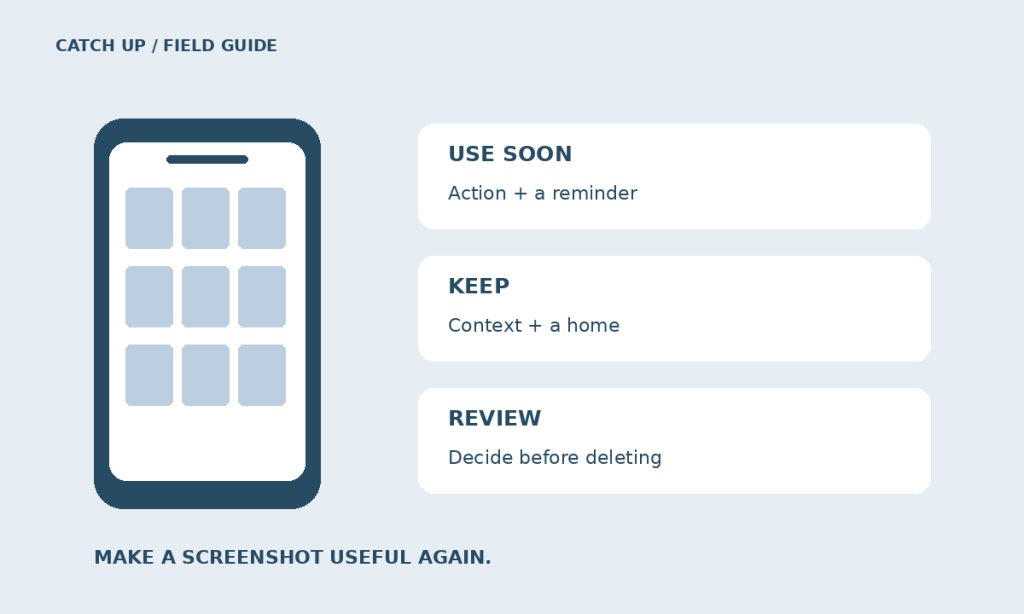
Open a recent batch and ask one question about each image: “What did I want to do with this?” Twenty is a suggested starting point, not a rule. The goal is to recover the reason you saved something before deciding where it belongs.
A recipe, a product comparison, a delivery notice, a sentence you meant to read again. Screenshots are easy to collect because saving one takes almost no planning. Finding a use for the collection is a different task. A few broad decisions can be more helpful than building a complicated folder system.
Find the collection before organizing it
Apple’s instructions place screenshots in Photos under Collections, then Media Types, then Screenshots. Its iOS 26 guide also explains how to customize Pinned Collections for frequently used groups. If your screen differs, check the official instructions linked below for the layout you are using.
Choose a boundary before opening the first image: the most recent 20, one week, or a single event. A boundary gives the session an end. You can finish a useful piece of the job without solving years of accumulated digital clutter.
Sort by next action, not just subject
A screenshot of a desk organizer might be a purchase you are still comparing, a model number you need to remember, or a product you no longer want. All three images fit a “shopping” album, but they need different decisions.
| Bucket | The question | A possible next step |
|---|---|---|
| Use soon | Is there an action I still want to take? | Add ingredients to a shopping note before trying the recipe. |
| Keep | Will I need this information or image again? | Record a device model in the note where you keep its manual. |
| Review | Do I still know why I saved it? | Check whether that purchase or event is still relevant. |
These are decisions, not mandatory album names. Use soon means an action is still wanted; Keep means the reference purpose is clear. Review is temporary. You can track all three in one note without moving any images.
Keep the context that makes the image useful
A product screenshot might need its model, the reason you are comparing it, and a link back to the original page. An event image may need a date and a decision about attending. A visual reference may be useful precisely because it is a picture, so converting it into text would miss the point.
Saved item: a desk organizer I am considering
Why I saved it: check whether it fits my drawer
Next action: measure the inside of the drawer
Retrieval location: my note titled Desk drawer — organizer fit
Source to revisit: original product page, linked beside the screenshot
Review point: Sunday, when I choose desk storage
Final decision: not yet made; fill this in after the fit check
This is a hypothetical example. Notice that the next action is a measurement, not a purchase. The note turns a passive image into a question you can answer.
Continue that fictional example in a note titled “Desk drawer — organizer fit.” Keep the screenshot and original page link with the question, so you can retrieve them by the project name. After measuring, record the usable drawer dimensions and compare them with the exact product dimensions on its page. If a dimension is missing, the next action becomes “find the missing measurement,” not “buy organizer.”
For anything in Review, use one sequence: resolve why you saved it, assign a next action or retention reason, and set a revisit point only if the question remains open. In the organizer example, Sunday is that point. Once the measurement resolves the fit question, fill in the final-decision line—for example, “Does not fit; comparison closed.” This is an editorial suggestion, not an automatic deletion rule.
Make deletion the final decision
First confirm that you can find the information you intended to keep. Then decide what you no longer need. Similar-looking images may contain different dates, order numbers, or details. Review those differences before selecting a group to remove.
Do not discard an original record simply because you copied a few words from it. Receipts, documents, and important conversations may have a purpose that a short summary does not preserve. When that purpose is unclear, leave the item in review rather than treating a cleaner library as the only goal.
For your next screenshot, capture its purpose while the reason is fresh: an action to take, a reference to keep, or a question to revisit.
Sources and scope
The navigation details follow the linked Apple instructions. The sorting method and batch size are editorial suggestions.