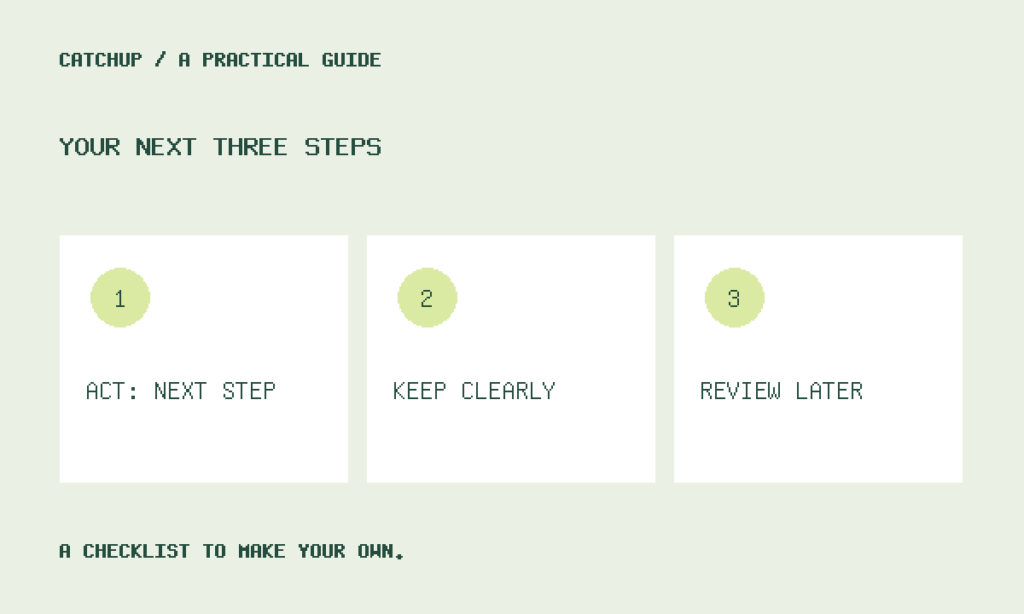
Sort downloads by next responsibility, not by file format: Act holds commitments, Keep holds known reference material, and Review holds uncertain items with a scheduled decision point.
A downloads folder becomes difficult to process when it mixes unfinished tasks, useful reference material, and files you do not yet understand. Sorting by file type or date changes the order, but it does not answer the practical question: What should happen next? Use a three-way intake routine instead. Every file goes to Act, Keep, or Review, based on the commitment attached to it.
Start with one decision question
For each file, ask: “What responsibility does this create?” If it supports a specific unfinished action, send it to Act. If its future purpose is already clear and no action remains, send it to Keep. If you cannot confidently choose either, send it to Review.
These are roles, not permanent folder names. Act is a short queue, Keep belongs within your existing reference categories, and Review is a temporary holding area. The original downloads folder remains an inbox rather than becoming a fourth destination.
Give each destination a strict entry rule
Act accepts only files connected to a concrete next step. Rename or note that step in plain language, such as “submit with application” or “compare before meeting.” A file that merely seems interesting does not qualify.
Keep accepts files with a known retrieval reason. Place each one with the subject, project, person, or record it belongs to. Review accepts genuine uncertainty: unfamiliar attachments, materials for possible projects, or files that need context. Give Review a recurring check date so uncertainty does not quietly become storage.
Hypothetical worked example: ten mixed downloads
Suppose Maya opens her downloads folder and finds ten files: a blank reimbursement form, a completed workshop worksheet, a neighborhood map, two logo drafts from a collaborator, a recipe PDF, an unexplained spreadsheet, a conference agenda for next month, a furniture measurement sheet, and a background image she might use someday.
She sends the blank reimbursement form to Act because it must be completed and submitted. The two logo drafts also go to Act with the decision “choose one and reply.” The conference agenda goes to Act because she wants to add selected sessions to her calendar. These four files support three actions: the two logo drafts are separate files used for one decision.
The completed workshop worksheet goes to Keep with her workshop notes. The neighborhood map goes to Keep with trip planning, and the furniture measurements go to Keep with home records. The unexplained spreadsheet goes to Review until she identifies its source. The recipe and possible background image also go to Review because their purpose is still speculative. Maya now has four files supporting three actions, three known reference files, and three files with explicit decisions to revisit—not one pile of ten unrelated files.
Process the queues in different ways
Work through Act by completing the named next steps, not by repeatedly reorganizing the files. When an action is finished, decide whether its supporting file now belongs in Keep or no longer needs a place in your active system.
Organize Keep for retrieval. A useful destination answers “Where would I look for this?” Review works differently: at each scheduled check, promote an item to Act, assign it a clear home in Keep, or decide that it has no continuing role. If context is still missing, record exactly what information would resolve the decision before the next review.
Use a small rule when the choice feels blurry
If a file could fit two destinations, choose according to what must happen first. A signed document that still needs to be sent belongs in Act before it becomes a kept record. A guide you may read someday belongs in Review until you can name when or why you will use it.
The routine succeeds when each destination stays honest. Act should describe real commitments, Keep should contain material with a recognizable home, and Review should carry a decision date. That distinction is more useful than a perfectly tidy collection of ambiguous files.
Your checklist
- Name the next step for every file placed in Act.
- Place each Keep file with a specific subject, project, person, or record.
- Set a recurring date to process the Review queue.
- For every reviewed file, choose Act, Keep, or no continuing role. Keep an unresolved item in Review only with the missing detail recorded and another decision date.
- Finish the intake pass with no undecided files left in Downloads.
The goal is not an empty folder for its own sake. It is a trustworthy intake point where every download quickly gains a next action, a known home, or a date for a real decision.