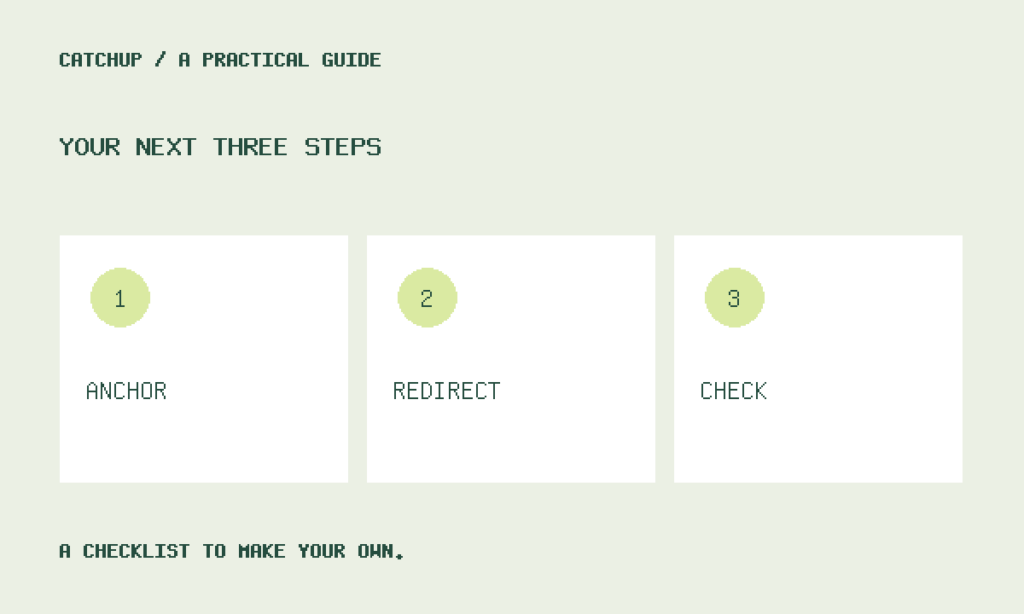
Treat the follow-up as a correction to the draft’s direction: Anchor one useful element, Redirect the piece toward the reader’s real problem, and Check the revision against a visible outcome.
A draft can be polished and still solve the wrong problem. In that situation, requests such as “make it more useful” add preferences without identifying the misunderstanding already on the page. The better follow-up is an editorial diagnosis: say what should survive, where the draft went off course, and what a corrected version must let the reader do.
Decide which problem matters most
Read the existing draft once for direction rather than sentence quality. Ask: Does it answer the wrong question, bury the right answer, or present relevant information in an unusable form? Choose the most consequential miss. A list of every weak phrase can obscure the correction that would improve the whole piece.
If it answers a neighboring question, restate the reader’s actual question. If the answer is buried, name the idea that deserves priority. If the material is relevant but hard to use, specify the decision, sequence, or comparison that should organize it. Tone edits can wait unless the tone itself blocks the reader’s task.
Build the follow-up from three decisions
Anchor one specific part worth keeping: a scenario, explanation, audience, tone, or example. “Keep the opening situation involving a neighborhood potluck” is clearer than “Keep the good parts.” The anchor prevents useful material from being discarded during the change in direction.
Redirect by contrasting the draft’s current destination with the intended one. A useful sentence is: “The draft currently focuses on X, but the reader needs Y.” Then identify material that should be removed or reduced because it supports X rather than Y.
Check the outcome with something visible in the revised text. Complete this sentence: “The revision works if the reader can…” Choose an action such as decide, compare, prepare, or explain. The check should evaluate the result without dictating every sentence.
Before: a vague reaction to an off-target draft
Hypothetical off-target draft excerpt: “A successful neighborhood potluck starts with invitations, a welcoming location, serving tables, labels, decorations, and a cleanup plan. Assigning dishes early helps the event run smoothly.” The passage is coherent, but it treats the assignment as event planning. The intended reader problem is narrower: how much food should each household bring.
Hypothetical vague follow-up: “This is not quite what I meant. Make it more direct and practical, focus on the main point, and improve the ending.” This communicates dissatisfaction but leaves “main point” undefined. The next version could shorten the event-planning advice without correcting the subject.
After: a precise revision brief and corrected result
Hypothetical precise follow-up: “Keep the neighborhood potluck scenario and friendly tone. The draft currently explains how to organize the event, but the reader needs to decide how much food each household should bring. Center the revision on that decision. Organize the guidance first by whether attendance is confirmed or uncertain. Within either situation, explain how dietary needs may change the mix of dishes, not the attendance category. Remove invitations, decorations, and cleanup advice. The revision works if readers in either attendance situation can identify a quantity approach and one adjustment for dietary needs.”
Hypothetical corrected excerpt: “For this fictional planning exercise, assume 12 confirmed guests, three households bringing side dishes, and an organizer’s chosen target of one side-dish serving per guest. That target gives 12 servings to allocate: four from each household. If attendance is only estimated at 12–18, the same assumption gives a range of four to six servings per household; confirm the count before choosing a number. If the group requests a dairy-free option, ask one household to choose its four-to-six-serving dish around that preference while keeping the same allocation.” These numbers are invented inputs and an illustrative allocation rule, not tested portion guidance or advice about dietary safety.
Compare the corrected excerpt with the Check: the confirmed case produces four servings per household; the uncertain case produces a stated range and a next question; a preference changes the assigned dish without becoming another attendance category. If the revision had only said “bring an appropriate amount,” it would still fail that Check.
A compact brief to reuse
Anchor: Keep [the exact passage, example, or audience that still works]. Redirect: The draft currently answers [X], but the reader needs [Y]. Remove or reduce [the distracting material]. Check: The revised text must let the reader [observable action] using [information actually supplied].
After receiving the revision, point to the sentence, table, or example that satisfies the Check. If you cannot identify it, name that missing result in the next edit instead of asking for another general polish.
When a light correction is enough
Consider another fictional draft: it opens with three paragraphs about why project handoffs matter, but its final paragraph already contains the useful handoff fields: goal, current state, files, and next action. The answer exists; it is buried. A full rewrite could discard useful content without solving the placement problem.
A light brief could say: “Anchor: keep the four handoff fields and their examples. Redirect: move those fields directly after the introduction and shorten the background to one sentence. Check: a reader should reach the complete field list before the first long explanation.” Verify the revision by locating that list. This changes the hierarchy while preserving the existing answer, whereas the potluck example required changing the question being answered.
Keep the useful part, name the misunderstanding, and inspect the corrected result against one observable test.