Choose around three things: a specific carry list, the items you reach for while other things remain packed, and the groups you want to keep together.
The notebook fits. So do the lunch container and the sweater. But if getting the notebook means lifting out lunch, a bag can hold everything and still make an ordinary day awkward. Before choosing a bag, write down the sequence it needs to support.
Carry and Access Worksheet
OUTING
Where I am going, including stops:
Beginning and end of outing:

CARRY LIST
Repeat for each actual item.
Item:
Routine or conditional:
If conditional, when it comes along:
Access role: reach / settle / reserve
Organization preference: alone / with __________ / open

ACCESS SEQUENCE
Repeat for each time I open the bag.
Moment or stop:
Item taken out or returned:
What remains packed:
What I do not want to move to reach this item:

GROUPS
Items I want to retrieve together:
Items I want in distinct places:
Items that can share the main space:

ARRANGEMENT SKETCH
Draw one box for each group. Show which items must remain reachable while the other groups stay packed.

MY BAG BRIEF
For __________, I routinely carry __________.
I also carry __________ when __________.
I need to reach __________ while __________ stays packed.
I want __________ together and __________ in a distinct place.

CANDIDATE CHECK
Bag being considered:
Actual load tried together:
Access sequence tried:
Steps that required unwanted unpacking:
Questions still untested:
Does this arrangement satisfy my brief? Why?
Which version of my day should I map?
Pick one recurring outing with a clear beginning and end: leaving for work and returning home, an afternoon of classes, or a Saturday with two stops. Avoid combining every possible activity into one imaginary day. That produces a bag brief for a load you may never carry.
On paper, name the outing and list the actual items that accompany it. Be specific enough to recognize each object: “blue notebook” is more useful than “work stuff.” Mark each item R for routinely carried on this outing or C for conditional, then name the condition. A sweater might be conditional on an evening stop.
If two outings require substantially different loads, give each its own worksheet. You can later decide whether one bag needs to serve both, but keep the evidence separate first.
How do I turn that list into an access map?
Replay the outing in order and write each moment when you open the bag. Beside each moment, name the item you take out and what stays inside. Include putting things back: a folded sweater returning to the bag is part of the load, too.
Then give each item an access role. Use “reach” for something you want to retrieve while the rest remains packed, “settle” for something you use after arriving and unpacking, and “reserve” for something carried just in case. These are your preferences for this outing, not permanent categories for the objects.
The useful detail is the relationship between items. “Notebook must come out while lunch stays packed” tells you more about the arrangement you need than “easy access.”
How much organization do I actually want?

For each item, write “alone,” “with…” or “open.” Alone means you want a distinct place for it. With means you want to retrieve it alongside named companions. Open means you are comfortable letting it share the main space.
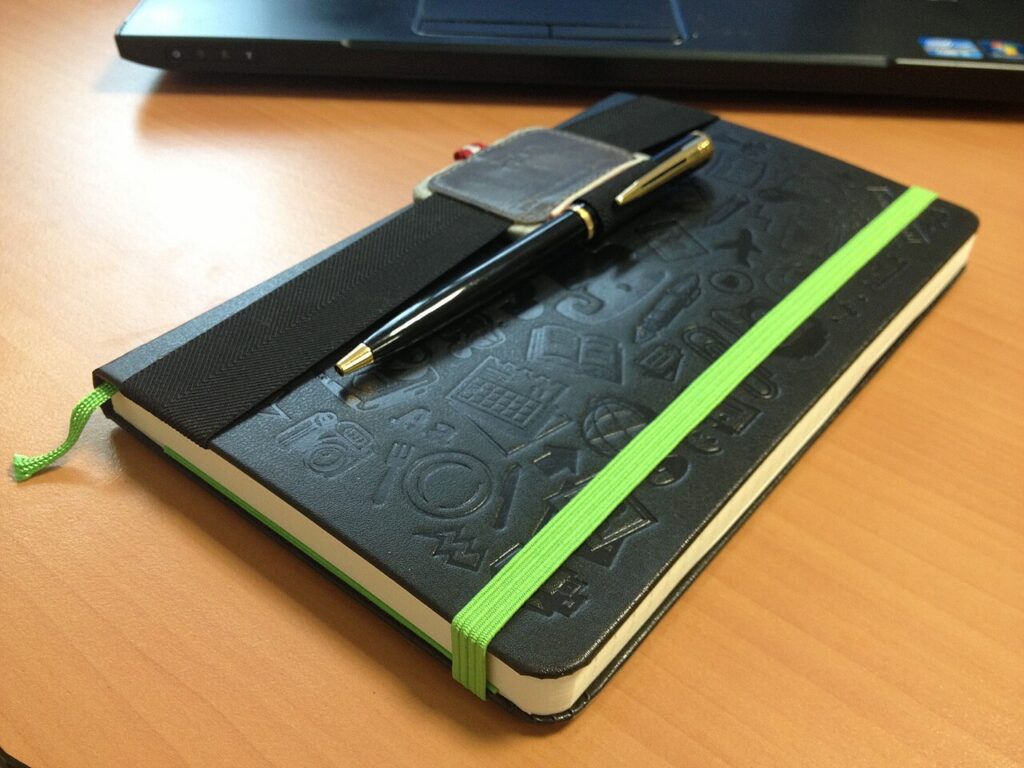
Count these groups rather than requesting a pocket for every object. A pen and notebook might form one group. Three small objects you use separately might deserve three distinct places—or one shared place if that matches how you prefer to search.
Finally, draw a rough arrangement using boxes. Put reach items where their retrieval does not require moving settle or reserve items. This is a relationship sketch, not a sewing pattern: it describes what must stay accessible without prescribing an exact bag shape.
What does a completed map look like?
Hypothetical example: Elena is choosing a bag for a workday followed by an evening class. Her routine load is a notebook, pen, lunch container and sweater. She also carries a library book only on return days.
Her sequence is notebook out at the morning meeting, lunch out at noon, notebook out again in class, then sweater out before leaving. She marks notebook and pen as one reach group, lunch as settle, and sweater as reserve. The library book is conditional and needs to come out at a stop on the way home.
Her sketch places the notebook-and-pen group beside the lunch space rather than underneath it. The sweater can share the main space, but cannot cover the notebook’s retrieval path. On library days, the book needs its own reachable position. Her brief now asks for two routine access relationships and one conditional arrangement, rather than an unspecified number of compartments.
How does the worksheet help me choose?
Use the map to explain what a candidate bag must accommodate. Check the actual objects together when possible; a paper sketch does not establish physical fit. Follow your recorded sequence, including returning items, and note any step that requires moving something you wanted to leave packed.
Treat an untested requirement as a question, not a passed check. If several options support the same load and sequence, your organization preferences become the deciding factor. The finished sentence should be concrete: “I want my notebook and pen together, reachable while lunch and my sweater remain inside.”
A useful bag brief describes a day in motion. Keep the worksheet specific enough that you can act out that day with the objects you carry.