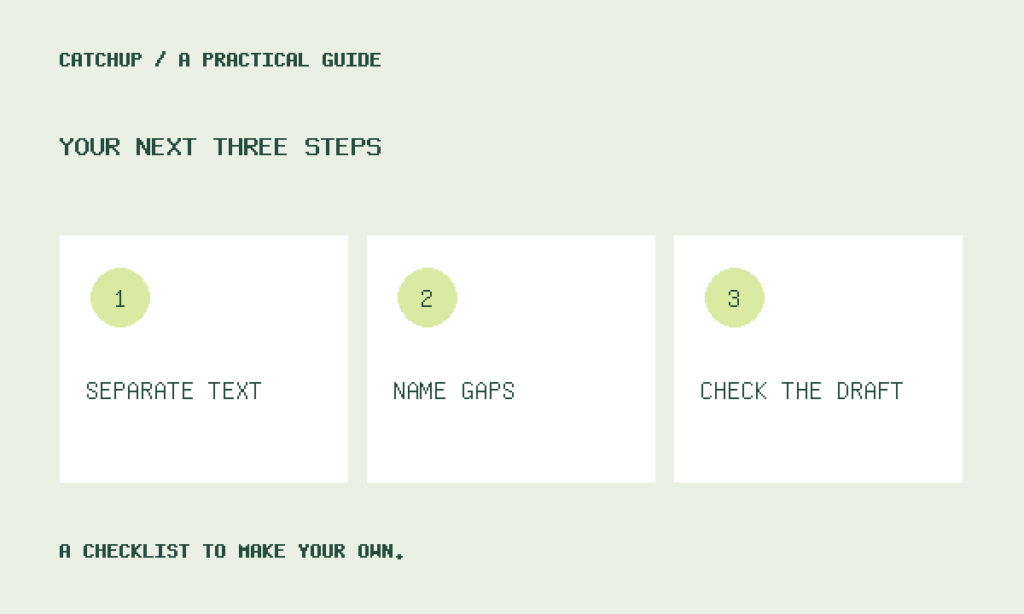
Keep your directions outside the source block. Give unknowns a separate home, then check the draft against the task you actually assigned.
A copied email can contain a request. Meeting notes can contain suggestions. An old announcement can include directions that no longer apply. When you paste them into a writing request, those sentences need context: are they material to describe, or instructions for the new draft?
Hypothetical example: a complete book-swap writing request
TASK
Write a neighborhood book-swap reminder of 60–90 words for residents. Use a warm, straightforward tone. Include the date, time and building name from the source. The current plan is that people may bring any number of books; make that clear. Include the fact that people may attend without bringing books. Return only the reminder.

SOURCE
The following notes are reference material. They include an older suggestion; the current requirements are stated in TASK.
BEGIN SOURCE
Event: Neighborhood book swap
Date: October 17
Time: 2–4 p.m.
Building: Maple Community Center
Earlier planning note: Tell everyone to bring ten books.
People may attend even if they have no books to bring.
END SOURCE

MISSING INFORMATION
The room assignment is unknown. Omit the room from this reminder; do not invent one or insert a placeholder.

FINAL CHECKS
Confirm that the reminder includes October 17, 2–4 p.m. and Maple Community Center.
Confirm that it allows any number of books and welcomes people bringing none.
Confirm that it does not repeat the older ten-book requirement or name a room.
Confirm that the reminder is 60–90 words.
What belongs in the instructions, and what belongs in the source?
Instructions describe the work you want done now: what to write, who will read it, what to include and what to leave out. Source material is the text the writer should consult, summarize or transform. A sentence can sound like an instruction and still belong in the source because someone else wrote it for a different purpose.
Use an ownership test: “Am I asking for this now, or am I showing something that was said?” Put your current requests under TASK. Put the material you are showing under SOURCE, between explicit beginning and ending labels. Preserve its wording; explain your current decision outside that block.
Why give missing information its own place?
An unanswered question is neither a fact nor necessarily a reason to stop drafting. Under MISSING INFORMATION, name each gap and say what should happen because of it: ask you before writing, leave a visible placeholder or omit that detail.
Choose based on whether the draft can serve its purpose without the answer. A missing event date may block an invitation. A missing room assignment may be omitted from an early reminder. State the choice so the writer does not have to infer it from scattered notes.
What does the layout look like in practice?
Hypothetical example: You are preparing a short reminder for a neighborhood book swap. Your notes include an older suggestion to ask everyone for ten books, but the current plan is to let people bring any number. The notes also lack a room assignment.
The request below keeps the old suggestion visible as background while placing the current requirement in TASK. It also specifies how to handle the room gap. The final checks test those exact decisions.
How should final checks differ from the task?
TASK tells the writer what to make. FINAL CHECKS names the few mistakes you especially want caught before delivery. For this reminder, the checks should catch an invented room, a revived ten-book requirement and an omitted date or time.
Make each check answerable by inspecting the draft. “Is it good?” gives little direction. “Does it say people may bring any number of books?” points to a concrete requirement. If a check introduces a new request, add that request to TASK too.
Will these labels make every response follow the request?
No. This is a writing organization method, not a guarantee against prompt injection. Its purpose is to make your intended boundaries easier to read and review.
When revising the request, place each addition in its proper block. A changed requirement goes in TASK; another excerpt goes in SOURCE; an unresolved detail goes in MISSING INFORMATION. That keeps the next draft tied to a clear brief instead of a growing tail of mixed notes.
Reuse the layout below by replacing the task and source, then choosing an explicit response to each unknown.