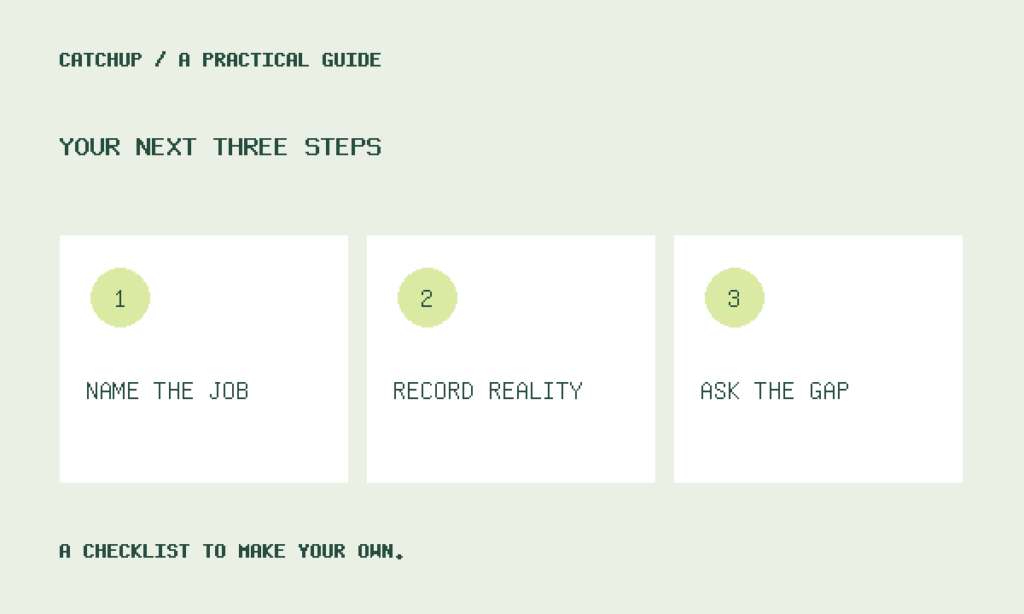
For every item, name the job, record the constraints and useful things already owned, then ask only the question that remains unanswered.
A wish list can preserve an idea without helping you decide. “Desk mat,” for example, names an object but leaves the important work undone: What problem should it solve, what must it fit around, and what do you still need to learn? Use a Job–Reality–Gap record to turn each wished-for accessory into one focused question.
Hypothetical Job–Reality–Gap records
| Wish-list item | Job | Constraints | Already owned | Question still unanswered |
|---|---|---|---|---|
| Pen cup | Keep the pens used each day upright and within reach. | Must fit in a narrow corner and remain easy to lift for cleaning. | A shallow tray holds clips and two occasional markers. | How much upright capacity is needed for the daily-use pens without crowding the corner? |
| Book stand | Hold an open reference book where it can be read while writing. | Must fit behind the notebook, support the usual book size, and store flat when unused. | One bookend and a clear strip at the back of the desk. | What footprint can the open book and stand occupy without reducing notebook space? |
| Desk mat | Define a smooth area for handwriting and protect the main work surface. | Must stay within the writing zone and avoid the drawer edge. | A small coaster and a separate pad used under messy projects. | What mat dimensions cover the normal writing movement without interfering with the drawer? |
Copy-ready Job–Reality–Gap record
WISH-LIST ITEM:

JOB:
I want this item to ____________________.

CONSTRAINTS:
It must fit ____________________.
It must not interfere with ____________________.
It needs to be easy to ____________________.

ALREADY OWNED:
I already use ____________________ for part of this job.

QUESTION STILL UNANSWERED:
What do I need to measure, try, or inspect to determine whether ____________________?

ANSWER:
____________________

DECISION:
Keep, revise, or remove this wish because ____________________.
Start with the job, not the object
Write one sentence describing the change you want at the desk. Make it observable: keep loose pens together, raise reading material to a comfortable viewing position, or create a defined writing surface. Avoid broad aims such as “improve my setup.”
Next, record the boundaries that any solution must respect. Relevant constraints might include available width and depth, required portability, cleaning needs, or whether an accessory would block a drawer. These facts prevent the wish from drifting into a search for generally appealing objects.
Treat what you own as part of the answer
List only possessions that affect this particular job. A shallow tray already holding clips matters when considering a pen cup; an existing bookend may matter when considering a reading stand. This step can reveal that you need a different use for something you own rather than another object.
Then identify the gap between the job and the recorded reality. Phrase that gap as one question you could answer through measurement, a quick desk trial, or inspection of the item you are considering.
Hypothetical worked example: three desk accessories
The following hypothetical desk belongs to a person considering a pen cup, a book stand, and a desk mat. The records do not decide which item is best. They make the next piece of needed information explicit.
Notice that each question depends on facts already recorded. “Which pen cup should I get?” becomes a capacity question. “Do I need a stand?” becomes a fit-and-use question. “What desk mat is best?” becomes a surface-boundary question.
Answer one question before expanding the list
Test the easiest uncertainty first. Gather the pens that must be accessible and count or bundle them. Place the open book where the stand would sit and mark its footprint with scrap paper. Outline the proposed writing area with removable paper strips and check whether the drawer still opens comfortably.
Record the answer beside the item. If it resolves the gap, you now have a usable requirement. If it exposes another uncertainty, replace the old question with the new one instead of building a long chain of speculative questions.
Keep the record small
One job, a few decisive constraints, relevant owned items, and one unanswered question are enough. The record is successful when you can perform a simple check and use its result to keep, revise, or remove the wish-list entry.
Your checklist
- Describe the item’s job as one observable change.
- Record the space, use, and care constraints that could rule it out.
- List only owned items that overlap with the same job.
- Write one unanswered question that a measurement, trial, or inspection can settle.
A useful wish list is not a collection of nouns. It is a set of small, answerable decisions, each grounded in the desk you have and the job you want done.