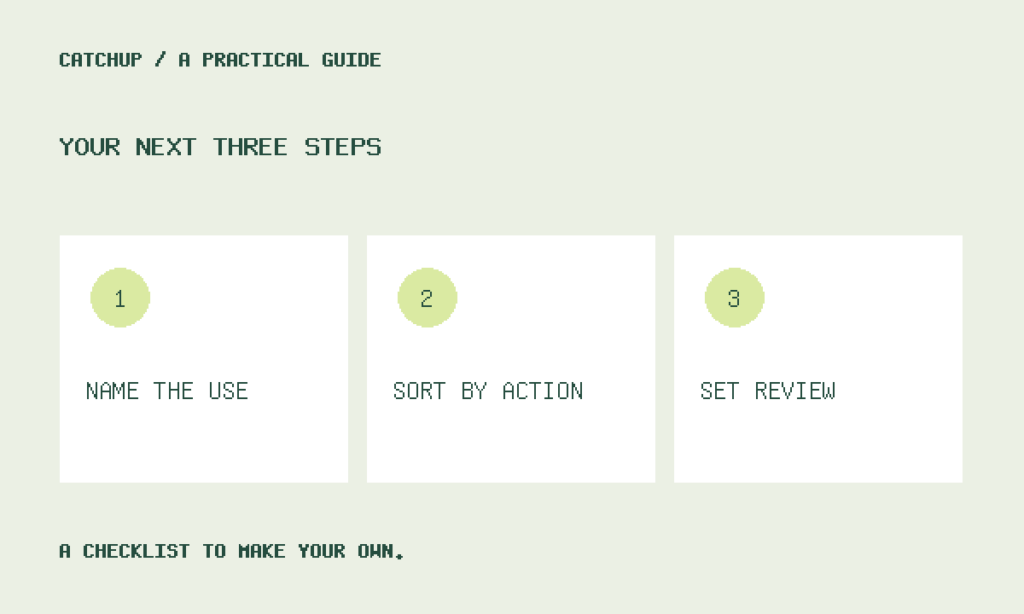
Use the sentence “I saved this to…” to expose each bookmark’s purpose. Route it to Action, Reference, or Review, then add the smallest cue needed to make that purpose usable.
A recipe you plan to cook, a transit map you consult every week, and an essay you may never read can all look identical in a bookmark list. Sorting them by subject does not resolve that ambiguity. Instead, classify each bookmark by the job it is meant to do.
Bookmark purpose decision guide
| Decision question | Route | Add this cue |
|---|---|---|
| Can I name a concrete next step? | Action | The next step and its endpoint |
| Do I know what information I will retrieve? | Reference | The future lookup phrase |
| Am I still deciding whether this is useful? | Review | One decision question and a review moment |
Begin with one purpose sentence
Take one bookmark and complete this sentence: “I saved this to…” Use a verb that describes your intended use, such as compare, submit, cook, check, quote, or decide. “Because it looked useful” does not qualify; it explains why you noticed the page, not what happens next.
The verb determines the route. A page connected to a defined next step belongs in Action. A page you expect to retrieve for known information belongs in Reference. A page whose value is still uncertain belongs in Review. These are working states, not permanent subjects.
Choose Action when a next step exists
Ask: “Can I name one visible thing I intend to do with this page?” If yes, classify it as Action and attach that step to the bookmark’s name or to a short companion note. “Community garden form — ask Dana about Saturday” is more useful than “Garden.”
An Action bookmark should also have an endpoint. Once the form is submitted, the comparison is finished, or the recipe is cooked, reconsider whether the page still has a reference job. This keeps completed intentions from masquerading as unfinished work.
Choose Reference for repeat retrieval
Ask: “What specific information would make me look for this again?” Reference is appropriate when the answer is already clear: a return policy, a measurement chart, a recurring event schedule, or instructions for a household routine.
Name the retrieval cue rather than the page’s broad topic. “Guest bed sheet measurements” is easier to recognize than “Home,” because it matches the future question that will bring you back. If you cannot imagine that question, the bookmark may belong in Review instead.
Choose Review when a decision is pending
Review is not a softer word for “keep forever.” Give each item a question that can be answered when you revisit it: “Is this worth reading this month?” “Does this explain the repair clearly?” or “Would I use any of these ideas for the reunion?”
Set a natural review moment, such as before planning the next meal, trip, or project. At that moment, promote the page to Action or Reference only if it has earned a specific purpose. Otherwise, decline to keep carrying it forward.
Hypothetical worked example
Hypothetical: Lena has eight bookmarks related to an upcoming family visit. She first writes a purpose sentence for each. “I saved this museum page to ask everyone which exhibit they prefer” becomes Action. “I saved this parking map to find the accessible entrance on arrival” becomes Reference. “I saved this neighborhood guide to decide whether anything fits our free afternoon” becomes Review.
She applies the same test to the remaining five. A reservation form and a recipe she plans to cook go to Action with explicit next steps. The train timetable and guest-room measurements go to Reference with retrieval-based names. An article about local architecture goes to Review with the question, “Would anyone want a short walking stop?” Her collection now expresses decisions, not merely the shared subject of travel.
Use a tie-breaker for ambiguous pages
If a bookmark seems to fit two routes, favor the more immediate job. A recipe you will cook Friday is Action today; after cooking it, it may become Reference if you expect to make it again. A guide you are evaluating remains Review until it produces either a next step or a known retrieval need.
The system stays small because classification follows intent. You do not need a new subject hierarchy whenever your interests change; you only need to know what role each saved page currently serves.
Your checklist
- Complete “I saved this to…” with a specific verb for each bookmark.
- Place pages with a defined next step in Action and state that step.
- Place pages with a known future lookup in Reference and name the retrieval cue.
- Give every Review page one decision question and a natural review moment.
- Reclassify an Action page after its next step is completed.
The useful question is not “Where does this page belong?” but “What am I expecting this page to help me do?” Once that answer is visible, even a modest bookmark collection becomes easier to act on, consult, and reconsider.