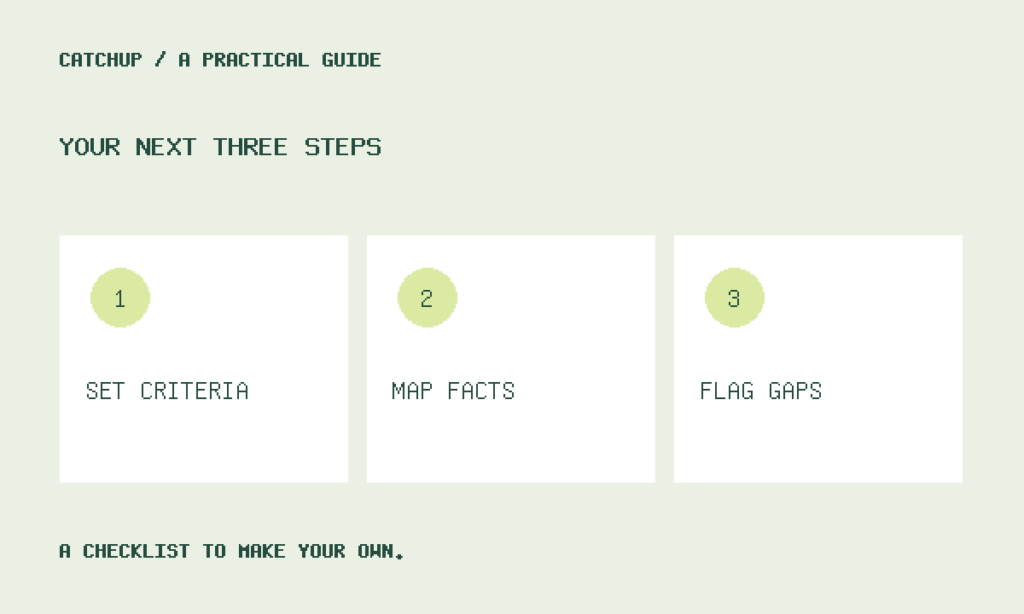
Define the criteria yourself, attach every fact to an option and criterion, and require the AI to label gaps instead of completing them.
A comparison can go off course before the first row is written. If you provide two options but leave the criteria open, the AI may fill that gap with assumptions about what matters. The remedy is a request built from three separate inputs: your criteria, your facts, and your rules for missing information.
Copy-ready fact-locked comparison request
I need to compare [OPTION A] and [OPTION B] for this decision: [DECISION].

Use only the criteria and facts below. Do not use outside knowledge, introduce additional criteria, infer unstated details, estimate values, or treat missing information as evidence.

CRITERIA, IN THIS ORDER
1. [CRITERION 1]: [WHAT IT MEANS HERE]
2. [CRITERION 2]: [WHAT IT MEANS HERE]
3. [CRITERION 3]: [WHAT IT MEANS HERE]

FACT LEDGER
[OPTION A]
A1. [FACT, INCLUDING ANY UNCERTAINTY]
A2. [FACT]

[OPTION B]
B1. [FACT, INCLUDING ANY UNCERTAINTY]
B2. [FACT]

Produce a table with these columns: Criterion | [OPTION A] | [OPTION B] | Missing information.

Use one row per criterion and preserve my criterion order. In each option cell, include only relevant supplied facts and cite their fact IDs in parentheses. Write “Not provided” when the ledger does not answer the criterion. In the Missing information column, ask the smallest specific question needed to fill each gap or resolve each conflict. If nothing is missing for a row, write “None identified from the supplied criteria.”

After the table, provide a neutral two-sentence summary of the documented differences and important gaps. Do not select a winner or recommend an option unless I add a decision rule.
Step 1: Write the decision and criteria separately
Start with one sentence naming the decision. Then list the criteria you want compared. A criterion belongs on the list only because you supplied it—not because the AI considers it customary, important, or useful.
Use concrete labels such as storage space, setup effort, delivery window, or return conditions. If a label could mean several things, define what it means for this comparison. For example: “Setup effort means the tasks I must complete before first use.”
Step 2: Build a fact ledger
Place each known fact under an option and a criterion. Give every fact a short ID, such as A1 or B3. These IDs create a boundary: the comparison may organize the supplied material, but it may not add unsupported details.
Preserve uncertainty in the source material. If your note says “delivery may take four to six days,” do not shorten it to “four days.” If two notes conflict, include both and tell the AI to mark the conflict rather than choose one.
Step 3: State the evidence rules
Tell the AI to use only the fact ledger, keep your criteria in the stated order, and cite the relevant fact IDs in each table cell. Prohibit outside knowledge, inferred features, guessed values, and newly invented criteria.
Also define the permitted gap label. “Not provided” is clearer than an empty cell because it shows that the omission was noticed. Ask for a missing-information column containing the exact question that would resolve each gap.
Step 4: Request a neutral comparison table
Use one row per criterion. The option columns should contain only supplied facts and their IDs. The final column should identify what is missing, conflicting, or too vague to compare. Ask for a neutral summary only if you want one, and prohibit a winner unless you have also supplied a decision rule.
Hypothetical example: A reader is comparing Option Birch and Option Cedar using only two criteria: storage space and setup effort. Their ledger says A1: “Birch has room for six labeled bins,” A2: “Birch requires attaching two shelves,” and B1: “Cedar arrives assembled.” The resulting rows should report those facts without assuming Cedar’s storage capacity or deciding that assembly is difficult. The missing-information column would ask, “How many labeled bins fit in Cedar?” and, if needed, “Does Birch require any setup beyond attaching two shelves?”
Step 5: Audit the result against the ledger
Read the table horizontally for completeness and vertically for invention. Horizontally, confirm that each criterion has a row and each gap has a useful question. Vertically, trace every claim in an option column back to its fact ID.
If a sentence cannot be traced, remove it or move it to missing information. If the AI introduced a criterion, delete that row instead of supplying facts for a question you never intended to ask. The finished comparison should expose the limits of your information, not conceal them.
Your checklist
- Every comparison criterion was supplied and defined by me.
- Every factual statement is traceable to a fact ID in my ledger.
- Missing details are labeled “Not provided,” not guessed or left blank.
- The missing-information column asks a specific question for each material gap.
- No winner or recommendation appears unless I supplied a decision rule.
The useful comparison is not necessarily the fullest one. It is the one whose boundaries you can see: your criteria determine the rows, your facts fill the cells, and unanswered questions remain visibly unanswered.